
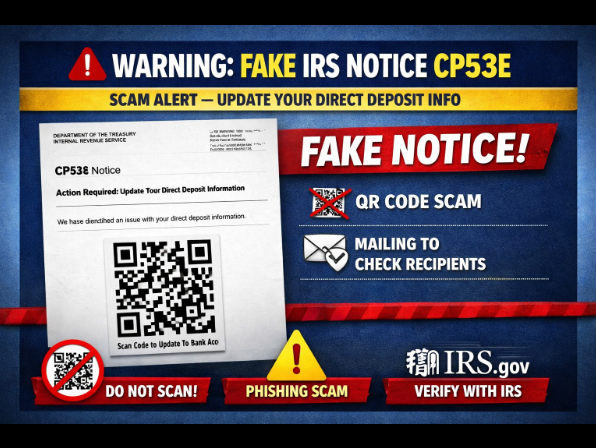

ALERT: New 2026 IRS Letter Scam (CP53E)
April 29, 2026
April 29, 2026
🚨 ALERT: New 2026 IRS Letter Scam (CP53E)
If you received an IRS Notice CP53E about a "direct deposit change" or "unable to process refund" notice, DO NOT act immediately.
Scammers are creating fake versions of this letter right now to steal your refund and personal information! 🛑
What you need to know:
- ✅ It’s a real letter, but often a scam: Many people are receiving fraudulent letters, while others are caught in an IRS glitch affecting 800,000+ taxpayers.
- ⚠️ The Red Flag: Scammers ask to click a link, scan a QR code, or provide Social Security Numbers via phone.
- 🛡️ Protect Yourself: The IRS will NOT send QR codes or demand urgent action via email.
What to do if you receive one:
- Do not call the number on the letter.
- Do log into your secure IRS online account to verify its legitimacy.
- Contact us immediately to verify your tax refund status before you click anything.
Stay safe this tax season!


By 7019370007
•
January 8, 2026
As important tax records start filling mailboxes, how can you make sure your tax preparation goes smoothly and efficiently this year? Here are some tips. Keep it all in one place. It seems obvious, but how often have you found yourself going through piles of paper looking for that elusive 1099 tax form or charitable deduction receipt? If you only do one thing, this is it. Time to sort. When you have everything all together, the best practice is to sort your information into the same buckets used in your tax return. At a minimum, sort the information into the basic categories below. If you have a lot of one category, sort that stack into the following sub-categories. A. Income Wages (W-2s) Alimony (pre-2019 divorce agreements) Business income (1099's, K-1s) Interest income (1099-INT) Dividends (1099-DIV) Winnings (W-2G, 1099-G) Social Security (SSA-1099) Investments (1099-B) Other Income Items B. Income Adjustments Student loan interest Tuition & fees deductions Alimony paid (pre-2019 divorce agreements) Educator expenses Other education expenses IRA contributions HSA/MSA contributions C. Itemized Deductions Taxes paid Charitable contributions Interest expense (mortgages) Medical/Dental expenses Investor/Other expenses Casualty/Theft losses D. Credit Information Child & dependent care expenses Adoption expenses Education expenses E. Business/Rental Sort income and expenses for each business activity, hobby activity, or rental unit Note: Remember, this list is not all-inclusive. It is here to help you sort your information into a usable form to make tax filing easier. F. New tax laws. This year there are new tax laws that require your attention: Tax-free tips. Get and retain records to prove any tip income from 2025. Tax-free overtime. Get your employer to provide records of any overtime you worked in 2025. Vehicle loans. If you purchased a new vehicle and have a loan on the vehicle, keep the detailed loan document. If the vehicle is U.S. assembled, this could be a new deduction for you. G. Not sure bucket. There may be things you receive that you aren't certain about needing for tax filing purposes. These items should be gathered in one place for review. Sum it up. Once the information has been categorized, create a summary of the information. This summary can be a printed copy of an organizer or it could be a simple recap you create. Is something missing? Pull out last year’s tax return and create a list of things you needed last year. Use this as a checklist against this year’s information. While this process will not identify new items, it will help identify missing items that qualified in prior years. Finalize required documentation. Certain deductions require substantiation and/or logs to qualify your expense. Common areas that require this are: business mileage, charitable mileage, medical mileage, moving mileage, non-cash charitable contributions, and certain business expenses. These logs should be maintained throughout the year, but now is a good time to make sure they are complete and ready to go for tax filing. It is very easy to overlook something given the lengthy list of taxable income items, deductions, and credits. By following these tips you can greatly reduce this risk.