

Client Update: May 2026
7019370007 • May 13, 2026

May 13, 2026

With so much uncertainty in the economy, the tendency is to step back and wait until things settle down. On the other hand the early bird catches the worm. Now is a great time to be thinking about steps to reduce your tax obligations, both this year and into the future. This month an article is presented for your review to get the ball rolling. There is also an article outlining the specifics of student loan payments being restarted after the Justice Department overruled several loan forgiveness initiatives.


Rounding out this months news, and on the heals of recent lawsuit wins regarding the addictive nature of social media, is an article about the comeback of traditional, slower-paced hobbies. Want to bake some bread, anyone?

IN THIS ISSUE

  • Time to Create Your 2026 Tax Plan
  • Higher Student Loan Payments on the Near Horizon
  • Five Small Business Insurance Review Tips
  • The Unexpected Comeback of Slow, Hands-On Hobbies
  • Time to Create Your 2026 Tax Plan

    Tax planning combines how much you think you will make, with the source (or how you make it), generating a tax effective result. This could make two clients with the exact same taxable income have entirely different looking tax bills. That's the hard news. The good news – now is the perfect time to review your situation. Here's a simple, but effective approach:


    Step 1: Take Inventory of your income sources

    Most income falls into a few core categories – wages from an employer, self-employment, freelance work, investment earnings, and any side income you pick up along the way. Other types of income you may have include:


    • Retirement income (pensions, Social Security, IRA or 401(k) withdrawals)
    • Rental income from real estate
    • Business distributions (for S-corp or partnership owners)
    • Interest from savings accounts or bonds

    If you aren't sure, take a moment and look at last year's tax return. It's a great place to start. Then consider any changes you expect.


    Step 2: Get familiar with the different types of taxes

    Not all income is taxed the same way. And these differences can add up quickly.


    • Wages are subject to a progressive income tax from 0% to 37%. So know the rate your next dollar of tax will pay. Also don't forget wages are subject to payroll taxes like Social Security and Medicare (7.65%).
    • Self-employment and freelance income is subject to the same tax rates as wages except most don't automatically withhold taxes and may also be subject to self-employment tax (15.3%). So planning here needs to consider quarterly estimated tax payments.
    • Investment earnings can be subject to a variety of tax rates such as interest and short-term capital gains (up to 37%), qualified dividends (0% to 20%), or long-term capital gains (0% to 20% depending on the holding period and income type).
    • Retirement income may be fully taxable (up to 37%), partially taxable (varies), or tax-free (0% for certain Roth distributions).
    • Rental income is generally taxed at ordinary income rates (up to 37%), though deductions can decrease your total taxable income.
    • Business distributions vary by entity and may be taxed at ordinary income rates (up to 37%) or pass through with no additional tax at the distribution level (varies).

    Step 3: Tips to manage your tax burden

    • Align your tax payments with how you actually earn. If a growing portion of your income is coming from somewhere outside a traditional job, withholding alone may not cover your tax liability. W-2 income is handled automatically, however freelance, investment, or rental income often requires quarterly estimated payments to avoid penalties.
    • Use withholding and estimates together. Adjust paycheck withholding to pair it with estimated payments when income is uneven or comes from multiple sources.
    • Pay attention when your income changes. These income shifts can catch people off guard with a higher tax bill if they don’t adjust their plan early in the year.
    • Be intentional about when income and expenses hit. Sometimes you have control over when you earn income or pay expenses. Used correctly, adjusting your timing can help smooth out your tax bill, especially if you’re self-employed or have investment income.
    • Check your plan throughout the year. Your income mix can change quickly, and small updates can make a big difference. A quick review during the year can help you stay on track and avoid surprises later.

    By understanding your income sources, how each is taxed, and how to align your payments and timing strategies, you can take a more proactive approach to managing this year's tax bill.

  • Higher Student Loan Payments on the Near Horizon

    The Department of Education recently announced that student loan borrowers who were awaiting loan forgiveness decisions will soon need to select a new repayment plan due to final determinations by the Supreme Court.


    Current Situation

    The SAVE Plan was a federal student loan repayment program introduced in 2023 by the former White House administration to lower borrowers’ monthly payments and expand pathways to loan forgiveness before being struck down by a federal court.


    According to the Department of Education, federal loan servicers will start issuing notices to borrowers on July 1 with instructions on how to transfer their loan balance from the SAVE Plan to one of the newly-approved repayment options. Borrowers will have a 90-day deadline to enroll in a new repayment option. (Servicers will notify borrowers of their specific 90-day deadline.)


    Tips to Manage the Change


    • Get familiar with your options. Borrowers currently enrolled in the SAVE Plan have approximately 6 months until their first payment under a revised repayment plan is due. Consider taking the next several weeks to learn about the different repayment options and which one fits best with your current financial situation.
    • Compare income-driven options carefully. Not all plans calculate payments the same way, and small differences in how income is defined can lead to big changes in your monthly bill. Look closely at how each plan treats discretionary income, family size, and forgiveness timelines before deciding.
    • Update your income and household information. Make sure your loan servicer has your most recent financial details. If your income has dropped or your family size has changed, you may qualify for a lower payment under a new plan.
    • Don’t wait until the deadline. You’ll have a limited window to choose a new repayment plan once notices go out. Submitting your application early can help you avoid processing delays, missed payments, or being automatically placed into a plan that may not be the best fit.
    • Consider making interest-saving moves now. While your loans may still be in forbearance, any voluntary payments you make can go directly toward your principal. Even small amounts paid now can dramatically reduce the total interest you’ll pay once regular repayments resume.
    • Explore forgiveness and employer benefits. Some borrowers may qualify for programs like Public Service Loan Forgiveness, or can receive help through employer student loan repayment benefits. It’s worth checking eligibility now so you can align your repayment plan with any long-term forgiveness or assistance opportunities.
    • Act like a banker. Remember, more money is made by the lenders when they get you to delay and lower your payment as much as possible. In fact, most interest earned on these loans happens in the first half of repayment. KNOW THIS and act accordingly. A good strategy might be to lower your monthly payment and then use the payment savings to front load principal payments.
    • Find the loan crossover point. This is the point where more of your monthly payment goes toward principal rather than interest. If you haven't reached yours, get there with a sense of urgency. A tremendous amount of interest expense can be saved for every dollar you pay down on the loan prior to this point.

    Finally, remember to run a monthly amortization schedule based on your planned repayment to understand how much interest you’ll pay over the life of the loan AND on each payment. This will allow you to move from a defensive posture to one of managing your loan to your advantage.

  • Five Small Business Insurance Review Tips

    Changes in your business equipment, real estate holdings, the amount of inventory, and the number of employees are all good reasons to review your business's insurance in addition to your annual review. Here are a few tips to keep in mind:


    • Stay in contact with your insurance company and your agent. Keep your insurance agent apprised of what you are doing in your business. Try to meet with your agent throughout the year, and conduct a detailed annual review of your insurance needs. Also do the same thing with your policy company. One of the often overlooked benefits of a good agent is their knowledge of various insurance companies and not just the one currently insuring your business.
    • Understand how business changes affect your policy. Figure out how your policy covers the changes you are seeing or anticipating in your business. This involves understanding the limits and terms of your policy. You can start by asking if you’re properly insured for property damage, liability coverage, security, health and disability, and changes in asset values.
    • Conduct a competitive review. Periodically conduct a competitive review of your insurance needs. Bring in at least two other insurance providers, as well as your current provider. The frequency of the review will be driven by changes in your business, the stability of your current insurance provider, and the need to understand the evolving landscape of business liabilities. A review will keep your premiums competitive, as well as help you learn about coverage gaps in your current policy.
    • Identify evolving coverage risks. As the business climate evolves, so should your insurance coverage. Think about what’s on the horizon. Legal trolls are active in areas like product packaging, use of images, and ADA requirements. And who would have anticipated the need to cover cyber attacks 10 years ago?
    • Review safety plans and company policies. This goes hand-in-hand with a business insurance review. Make sure your team is adhering to established employment and operations policies. Getting an insurance claim paid and maintaining reasonable premiums often depend on specific policies being in force prior to putting your policy in place.

    Finding the right level of coverage for the right price is possible, but it takes some preparation and planning. Invest some time now to review your insurance policies to save a lot of potential pain and money down the road.


  • The Unexpected Comeback of Slow, Hands-On Hobbies

    Life feels faster than ever, with pressure to do everything quickly and stay busy all the time. But a quiet shift is happening. More people are picking up hobbies that slow things down, choosing to take their time as a way to step away from screens. Here’s a look at why more people are drawn to hobbies and what this shift could mean for your own time and attention.


    Why these hobbies are popular

    Being constantly connected and expected to quickly switch between tasks is leaving people worn out. Many are stepping away from that noise, looking for activities that let them focus on one thing at a time and give their minds a break.


    At the same time, there’s a growing pull toward more mindful, intentional living. Hobbies offer something simple and satisfying – working with your hands, paying attention to small details, and enjoying the steady rhythm of making something over time.


    Examples of hobbies gaining traction

    Hobbies are showing up in all kinds of forms, from traditional crafts to modern twists. Knitting, sewing, and other hands-on crafts are drawing people in with their steady pace, while gardening offers a slower rhythm tied to seasons rather than schedules. Analog photography and film development are also making a comeback, inviting patience and surprise instead of instant results.


    In the kitchen, bread baking and long, unhurried recipes are becoming rituals rather than chores. Even hobbies that use modern tech can slow things down by design like digital illustration done in long sessions, or using apps to track and nurture plants over time. Model building, puzzles, and other detail-focused pastimes round it out, all centered on taking things one careful step at a time.


    The psychological benefits

    • Calm through repetition. Traditional hobbies often involve simple, repeated motions like stitching, kneading, sanding, planting. These rhythms can settle the mind and take the edge off stress. Over time, they also help you respond more evenly to frustration, building steadier emotional control.
    • Patience becomes a skill. Working slowly teaches you to wait without rushing the outcome. Progress happens in small steps. This changes how you relate to time. Instead of chasing quick results, you begin to enjoy the process itself and feel satisfied watching something take shape.
    • Connection over competition. Many hobbies naturally bring people together. Whether it’s a craft circle, a gardening group, or an online forum, there’s a focus on sharing rather than comparing. Skills and traditions get passed along, creating a sense of belonging that spans ages and experience levels.

    Hobbies offer a simple counterbalance to a fast-moving world. By making space for patience and attention, they bring a sense of calm and meaning back into everyday life. Sometimes, slowing down in small ways is enough to change how everything else feels.


As always, should you have any questions or concerns regarding your tax situation please feel free to call.

April 29, 2026
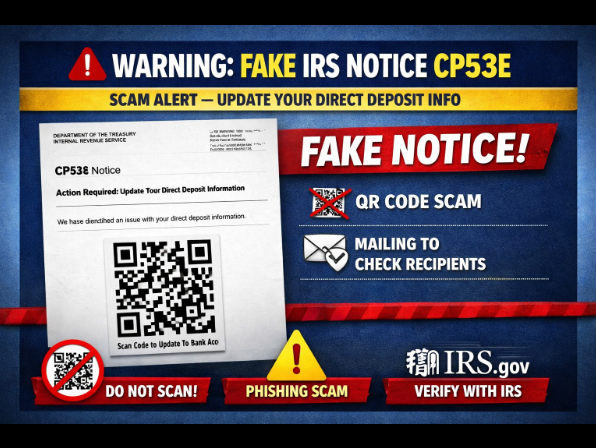
🚨 ALERT: New 2026 IRS Letter Scam (CP53E) If you received an IRS Notice CP53E about a "direct deposit change" or "unable to process refund" notice, DO NOT act immediately. Scammers are creating fake versions of this letter right now to steal your refund and personal information! 🛑 What you need to know: ✅ It’s a real letter, but often a scam: Many people are receiving fraudulent letters, while others are caught in an IRS glitch affecting 800,000+ taxpayers. ⚠️ The Red Flag: Scammers ask to click a link, scan a QR code, or provide Social Security Numbers via phone. 🛡️ Protect Yourself: The IRS will NOT send QR codes or demand urgent action via email. What to do if you receive one: Do not call the number on the letter. Do log into your secure IRS online account to verify its legitimacy. Contact us immediately to verify your tax refund status before you click anything. Stay safe this tax season!

certified public accountant
April 13, 2026
Here are some of the most common and costly mistakes individuals make and how partnering with a certified public accountant can help you avoid them.
tax preparation services
February 6, 2026
Maximize your refund with expert tax preparation services. Discover six insider tips to simplify filing and save more this year.
Show More →